Resize
OpenLvVision_OpenCv.lvlib:Resize.vim
Resizes an image.
The function resize resizes the image src to the specified size.
Note that the initial dst type or size are not taken into account.
Instead, the output size and type are derived from src, dsize, fx, and fy.
For detailed information, please refer to the OpenCV documentation
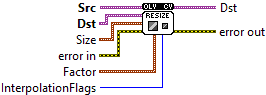
| error in error in can accept error information wired from VIs previously called. Use this information to decide if any functionality should be bypassed in the event of errors from other VIs. Right-click the error in control on the front panel and select Explain Error or Explain Warning from the shortcut menu for more information about the error. |

| status status is TRUE (X) if an error occurred or FALSE (checkmark) to indicate a warning or that no error occurred. Right-click the error in control on the front panel and select Explain Error or Explain Warning from the shortcut menu for more information about the error. |

| code |

| source source describes the origin of the error or warning. Right-click the error in control on the front panel and select Explain Error or Explain Warning from the shortcut menu for more information about the error. |

| Src input image. |

| Dst output image; it has the size dsize (when it is non-zero) or the size computed from src.size(), fx, and fy; the type of dst is the same as of src. |
| Size output image size; if it equals zero |

| X |
| Y |
| Factor |
| X scale factor along the horizontal axis; when it equals 0 |

| Y scale factor along the vertical axis; when it equals 0 |
| InterpolationFlags INTER_NEAREST: nearest neighbor interpolation INTER_LINEAR: bilinear interpolation INTER_CUBIC: bicubic interpolation INTER_AREA: resampling using pixel area relation. It may be a preferred method for image decimation, as it gives moire'-free results. But when the image is zoomed, it is similar to the INTER_NEAREST method. INTER_LANCZOS4: Lanczos interpolation over 8x8 neighborhood INTER_LINEAR_EXACT: Bit exact bilinear interpolation INTER_NEAREST_EXACT: Bit exact nearest neighbor interpolation. This will produce same results as the nearest neighbor method in PIL, scikit-image or Matlab. INTER_MAX: mask for interpolation codes WARP_FILL_OUTLIERS: flag, fills all of the destination image pixels. If some of them correspond to outliers in the source image, they are set to zero WARP_INVERSE_MAP: flag, inverse transformation WARP_RELATIVE_MAP |
| error out error in can accept error information wired from VIs previously called. Use this information to decide if any functionality should be bypassed in the event of errors from other VIs. Right-click the error in control on the front panel and select Explain Error or Explain Warning from the shortcut menu for more information about the error. |

| status status is TRUE (X) if an error occurred or FALSE (checkmark) to indicate a warning or that no error occurred. Right-click the error in control on the front panel and select Explain Error or Explain Warning from the shortcut menu for more information about the error. |

| code |

| source source describes the origin of the error or warning. Right-click the error in control on the front panel and select Explain Error or Explain Warning from the shortcut menu for more information about the error. |

| Dst output image; it has the size dsize (when it is non-zero) or the size computed from src.size(), fx, and fy; the type of dst is the same as of src. |
